



Creche (nacimiento, nativity scene), c. 1966
Domingo and Chepa Franco
Saguaro wood, cloth, straw, board, paint
Purchase – Arizona Archaeological and Historical Society Discretionary Fund
Length: 68.5; width: 30 cm; height: 35 cm. (E-6730-x)
ASM ordered this nacimiento in 1964, and received it in June of 1966. Domingo Franco had passed away in May of that year. This was one of his very last works, after which time his wife Chepa took over the carving and the dressing of the figures. The Francos had also made a creche for the church at Pisinimo on the Tohono O’odham Nation, and perhaps made others on commission.
Spark (1990:4) provides this background on Franco creches:
For the most part, the works [of Chepa and Domingo] were narratives of the tasks which the Indians undertook in their daily lives. It wasn’t until 1965, in fact, that Domingo carved anything with extra-tribal significance. It was in that year that Father Camillus Cavagnaro of the San José Mission Church approached if Domingo could carve a creche scene for the mission’s Easter celebration. Chepa and Domingo, both highly religious Catholics, accepted the task without the blink of an eye.
They went on to produce two more nacimientos, the final one of which ended up in the permanent collection of the Arizona State Museum. All were doubtlessly striking judging from the piece at the State Museum.
This creche was included in a 1990 book Nacimientos: Nativity scenes by Southwest Indian Artisan, by Guy and Doris Monthan.
More from the Franco family below. Click on each image to expand content.


Chepa Franco's Solo Carvings

Chepa Franco, photographer Paul Sheldon, c. 1978. This photo appears in David and Spark's 1978 article in "The Clarion."

Witch (Ho’ok’oks) carrying children in burden basket c. 1970s
Chepa Franco
Cholla and saguaro wood, cloth, hair, leather, string, paint
Gift of Stephen Strom, 2017
Length: 19 cm; width: 17 cm; height: 29.2 cm. (2017-78-236)
An O’odham story features Ho’ok’oks, an old witch who steals children and eats them. She is finally killed by O’odham culture hero I’itoi, saving the people from her wrath. (see Evers, ed., 1980:110-121). According to the Southwest Folklife Alliance’s Lifeways in Wood, the Ho’ok’oks was one of Chepa’s specialties, and this appears to be one such. A child is hanging onto the side of the giho in the process of making an escape. According to Spark (1990:5), “Chepa’s figure [Ho’ok’oks] portrayed the children at the moment of escape, smiling at their cleverness and anticipated freedom.”
The donor and his wife, Karen, purchased this figure at Kitt Peak National Observatory in the 1970s.
An attached tag describes this figure very differently: “This is a ‘fun’ doll, your interpretation may be that the woman is caring for the neighbor’s children while the other women are out gathering cholla buds for salad or mesquite beans for meal, or saguaro fruit for syrup.” Did Chepa identify the woman as Ho’ok’oks to the Kitt Peak buyer, did she keep this bit of information to herself, or did she provide the more sanitized version to the buyer?
The Stroms worked as astronomers at Kitt Peak in the 1970s. As part of the agreement to build Kitt Peak on Tohono O’odham Nation land, the Tohono O’odham tribe stipulated that its gift shop carry O’odham crafts. Elizabeth Estrada (1909-1985) was the buyer who provided Kitt Peak with the O’odham crafts. (See Dittemore 2024: 94). Spark (1990: 5) credits Estrada with encouraging the Francos to sell their works at craft fairs, and urging Chepa to continue making the figures after Domingo’s death in 1966.

Woman carrying burden basket with children, c. 1970s
Chepa Franco
Cholla and saguaro wood, cloth, hair, fiber, paint,
Gift of Stephen Strom, 2017
Length: 16; width: 25; height 9 cm. (2020-428-3)
Donor Dr. Strom and his wife Dr. Karen Strom likely purchased this figure at Kitt Peak National Observatory’s gift shop.
This figure may represent Ho’ok’oks, an old witch who steals children and eats them in O’odham lore. (see Evers, ed., 1980: 110-121). The accompanying tag reads: “The burden basket contains two girls who seem to be playing: one has the spoon in the dish in which white cheese is being carried.” Given this description, it may not be Ho’ok who is represented, but a woman with her children eating from a batea, or cheese making tray, that looks like it once held a white cloth to represent the cheese. Only a small fragment of this cloth remains.
More from Chepa below. Click on each image to expand content:


Domingo Franco's Solo Works

Covered wagon lamp, c. 1953
Domingo Franco
Cholla and saguaro wood, paper, paint, electrical cord, devil’s claw
Gift of Edna Smith, 2002
Length: 20 cm; width: 9.8 cm; height: 24 cm (2002-284-1)
The lamp and painting illustrate Domingo Franco’s artistry. Nichola Spark (1990:2) sets the stage, when Franco began to make covered wagons of his own in the 1920s after supplying Anglo craftsman Hall with cholla wood:
It took a while, but soon Domingo became proficient enough to make the lamps. Unfortunately, making the lamp bodies wasn’t enough, since the prototypical covered wagon lamps desert scenes painted on the shades (modern versions, of course, use photographs). Domingo, not one to be discouraged, tried to paint the parchment covers and discovered, quite accidently, that he had a talent for painting. Before long, Domingo was painting pictures not just on lampshades, but on large metal or cloth canvases.

Painting of desert scene with horse and rider, c. 1960
Domingo Franco
Oil on board, saguaro wood frame
ASM purchase from Kieran Bridenthall, O.F.M., 1971
Height: 46 cm; width: 60.5 cm (L-315)
Thomas Franco
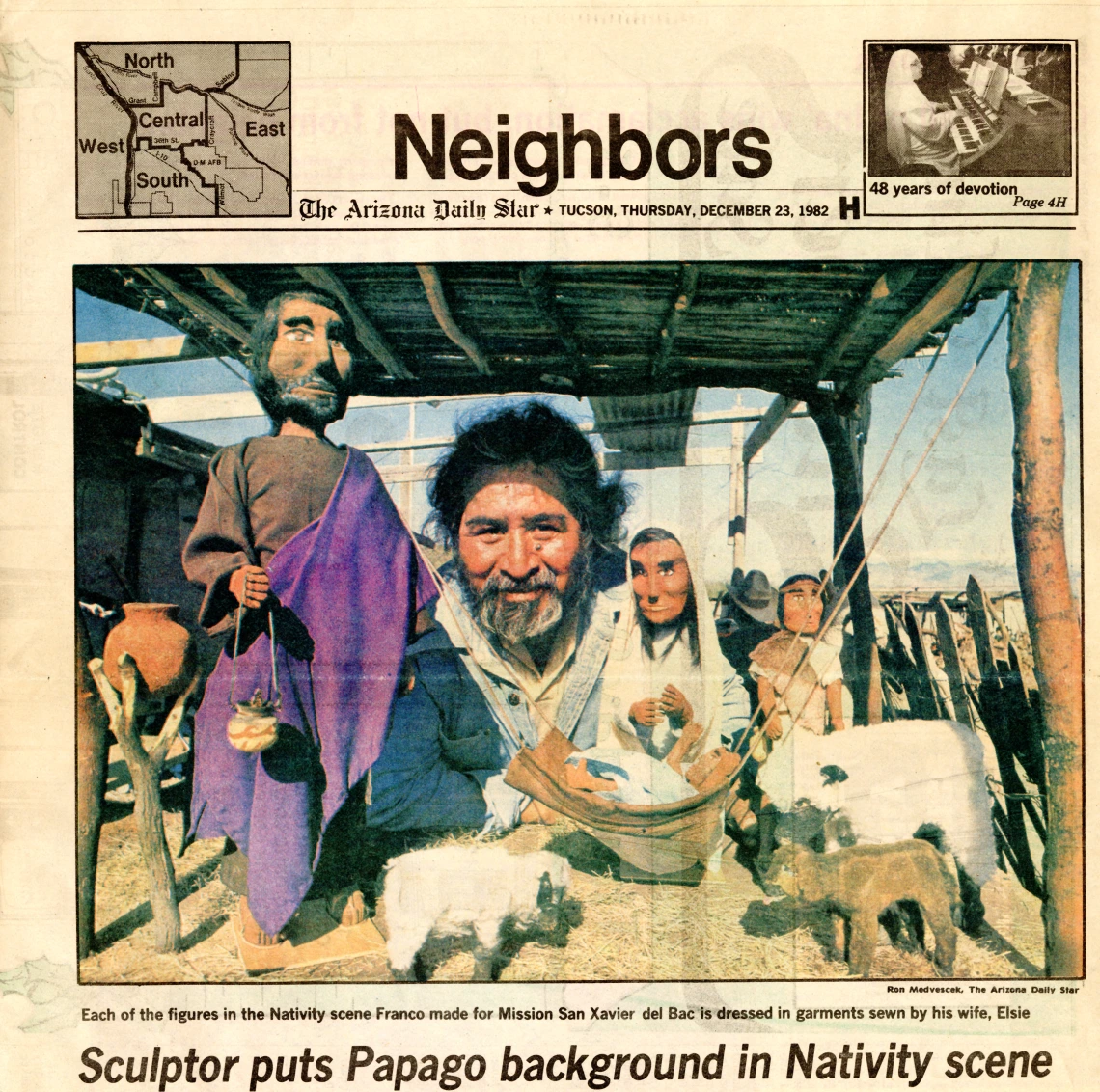
Article about Thomas Franco in Arizona Daily Star, December 23, 1982.
Thomas Franco took up the cactus craft of his parents, first assisting them and then going on his own. Spark (1990:1) wrote: Thomas remembers the first time Domingo showed him how to carve. “This was my father’s life,” he says, “and it started with him. I just watched a while. . .”
In addition to dolls, Thomas also made whole tableaux with more modern O’odham cultural themes. Spark (1990: 9) describes one such: “Recently, Thomas built a diorama depicting a Papago frybread stand. It is an aspect of modern Papago life, certainly, and Thomas creatively handled the subject with the same sort of wry humor of Chepa’s “Waiting for the Bus.”
Thomas Franco affixed his figures on commercial wood rather than cholla wood bases. For this reason he was identified as the likely maker of the carvings presented here, which were a gift to ASM from Diana Wu David whose mother Eloise Jensen had collected them.
According to Spark (1990:7), Thomas’s wife Elsie clothed the dolls just like Chepa had done for her and Domingo’s collaborations.

Man plowing with mule, c. 1970s-1980s
Attributed to Thomas Franco, clothes likely made by his wife Elsie
Saguaro wood, cloth, hair, wire, prickly shrub, paint
Gift of Diana Wu David, from collection of her mother, Eloise Jensen, 2020
Length: 48.6 cm; width: 13 cm; height: 24 cm. (2020-405-4)
Thomas Franco was well known for making genre scenes in addition to individual figures. ASM has no examples of such dioramas, so this photo of his outdoor kitchen, in a private collection, is included here. It is particularly appropriate, as the Franco family to this day operates a frybread stand at San Xavier Mission.
More from Thomas Franco below. Click on each image to expand content.


